Monday, June 25, 2012

I’m Not Having Children – And That's Okay.


http://www.psychologytoday.com/files/u669/dice.jpgOne of my many defining traits is a lack of desire to gamble. I don't like gambling with money, and I downright refuse to gamble with the life of another human being – especially a being that I will have to carry the bulk of the burden when creating it. I have to ask myself these questions beforehand. I don’t like to take risks. Call me boring or too careful, I don’t care. Having kids is rolling the dice. What if:
  •          The child is deformed?
  •          It’s handicapped?
  •          It has a learning disorder”
  •          It has Autism?
  •          It has ADHD?
  •          It has a terminal or painful childhood disease like leukemia, muscular dystrophy, or cystic fibrosis?
  •          It has a congenital disorder?

Judging from my previous “hard times,” I would not deal with this reality well…which makes the likelihood that the familial pattern of my childhood would reassert itself. This would include:
  •          Mental Illness
  •          Physical Abuse
  •          Alcohol abuse
  •          An absent father
People tell me not to worry – that I can handle it, if the time comes. I disagree – and I find the insinuation that they know my mind better than I do insulting and condescending.  They have many arguments that they use to try to get me to reproduce:

Q: Who will take care of you when you’re old?!
A: Nursing home attendants.  The same people that will be taking care of you, when your kids are too busy with their lives to care about you swimming in your own urine and getting bedsores.

Q: But your child could grow up to cure cancer!
A: I’m sure Charles Manson had a mom. Ted Bundy had a mom, too. Hitler had a mom as well. Need I go on?

Q: Do you hate kids?
A: Absolutely not. I hate loud, undisciplined kids.

Q: What if your parents didn’t have kids?
A:Then you wouldn’t be sitting here having this conversation with ME now would you?”

Q: You’d be a great mother –people like you SHOULD have kids!
A: You don’t know me well enough to gauge whether I’d be a good mother. I would be an awful, terrible mother. The only reason that you THINK I would be a good mother is twofold: you’ve only seen me with children that are well-behaved, and when they start to cry or pout, I hand them back over to their parents.

Q: Who will carry on the family name?
A: Our last name is Coleman. It’s so common that you can’t fling a dead cat without hitting someone with that surname. Even if it was rare, I wouldn’t care anyway. I don’t find my genetic material so great as to warrant passing it on to the next generation.

Q: What about your parents? Don’t you want to give them grandchildren?
A: The short answer: NO. The long answer: My mom can give a shit less. My dad does indeed care, but he acknowledges that it’s not his choice to make – and if it makes me happy, it makes him happy. My maternal grandmother went so far as to applaud my decision.

Q: But it’s the hardest/most important job in the world!
A: You’re kidding, right? I hope you don’t really believe that. I'm sure Air Traffic Controllers, Oil Rig Workers, and Coal Miners will disagree with you.

Q: Children are a woman’s greatest achievement!
A: You must have lived under a rock for the past half-century. Women are much more than baby-making machines now.

Q: You’ll change your mind.
A: No, I won’t. Ya know how I know that? Because my husband and I decided to get him a vasectomy. He is officially sterile. And, now that I think about it, that condescending statement implies that you know what I want better than I do. Really? I don't think so.

 NOTE: Child-free people call these questions (and others) a “bingo,” as if they’re keeping score on a bingo card

As a Buddhist, the reason for remaining child-free is even simpler. To experience suffering, you have to first be a living being. By not creating a living being, I am reducing the sum total of suffering in the world.

Also – those living now are almost guaranteed to suffer in the future. Human beings have made an undeniable mark on the planet, increasing greenhouse gases and gradually raising the temperature of the earth. Perhaps we will continue to do so, until the earth cannot sustain humanity. Food shortages will cause people to starve to death, lack of a convenient, clean water source is already causing conflict around the globe. Perhaps we will get wise to this, and do something constructive to fix it, but I doubt it. Denial is a unique way to deal with climate change, and one that has few rewards in the long run – but seeing the long view isn’t humanity’s strong suit.

http://www.pantene.com/en-US/PublishingImages/Article%20Content/img_wigs.pngAs a child-free person, I have more to give to the world. I may not add my genetic material to the future mass of humanity, but I will do my best to make the world a better place. I have given to the Special Olympics, Pantene Beautiful Lengths, and a local homeless shelter. I have found time to volunteer at the Humane Society for Southwest Washington and the Multnomah County Library. I loan my friends money so that they can get into a new rental house or pay for books for college. I get gifts for those I love, not because it’s a holiday…but just because. 

I understand that most parents are proud of their parental status, and they should be – if, of course, they manage to raise a person that is a benefit to society. Most of my parent friends are terrific parents; their children reflect discipline and respect. 

Being a good parent is hard. I don’t want to be responsible for the raising and shaping of another human being. Parenting, for me, is like the experience of eating Brussels sprouts: I just don’t like them. I really don’t know why – but eating them is an experience that I prefer to forgo. So is parenting.

And here we are…a big reason that I don’t want children: I find pregnancy absolutely repugnant. I have no idea why – maybe it’s the thought of another being inside of me (GROSS!), or the horrible health issues that pregnancy causes: Google ‘Rectal Prolapse.’ I DARE YOU. (No, really, don’t. It’s gross). Maybe it’s the unnatural stretching of the abdomen, or how the belly button sticks out, sort of like one of those pop-out turkey timers.

Maybe it’s the result of the pregnancy:
http://mrsdubai.files.wordpress.com/2011/07/frazzled-mum.jpgPerhaps it’s the thought of having to take care of a screaming shit-storm for almost two years (I’m sensitive to sound, and easily irritated by shrill child screams). Perhaps it’s the worry that parents go through when their child goes missing, or the annoyance and anger when they get into trouble. Perhaps it’s the money that’s spent on child-rearing (almost $227,000.00, not including college.) Perhaps it’s the hassle of getting kids ready to go anywhere. Perhaps it’s the loss of self when you have children – women especially tend to identify themselves based on their relationships to others…and every mother that I have ever known describes herself as a “mother” first – not an autonomous human being, as if her identity has merged with that of her child(ren).

In fact, I think that it’s all of those things, and a much more basic one: I don’t desire children. I never have, and never will. I have no biological clock. That doesn’t make me broken or strange – it just makes me different. I don’t understand why in the world that someone would want kids – oh, I KNOW why, I just don’t fully UNDERSTAND why. What I usually say when someone asks me why I don’t want kids is this: “I decided that I love kids – I just don’t want them. I’ll leave the breeding to the experts!”

   It’s true. I’m good at so many things – crochet, cross stitch, brewing mead, drawing, painting, crafting, spelling, and successful database searching, among other things. I have activities that I love to be able to do, things that I wouldn’t be able to do if I had kids – going anywhere at any time just because I want to, drinking a glass of wine at the end of the day, eating and cooking new and exciting dishes, going on beautiful and restful vacations, watching R rated movies without worrying, reading whatever I want whenever I want, and giving back to the community…via monetary means, volunteering, food donations or craft goods. I can do this because my time is my own. I can do this because my identity is not merged with another needy, clingy human being. I have the opportunity to make the best of my life, one day at a time...without children. And that's okay.
 
http://www.cottagegrove.com/images/slideshows/couple-fireplace-wine.jpg

Friday, June 15, 2012

How Star Trek Made Me an Atheist


About a year ago, I became intrigued with the phenomenon known as “Trek.” I wanted to experience Star Trek for myself, to know just what it was that made all those people act so weird. While watching the second season of The Original Series (known to Trekkies/Trekkers as TOS) I felt compelled to write about it in my English 101 class, in a “choose your own topic” assignment. The teacher loved my writing, and added glowing comments to my paper, even speaking with me about it after class. The topic was about the parallels between Star Trek and the Cold War – which my teacher found quite compelling. I did, too – and I even found other papers on the same subject – papers much longer and more scholarly than mine!
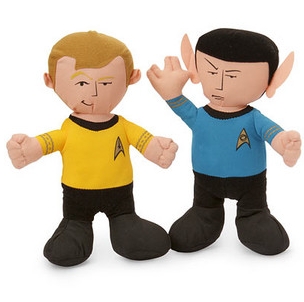
It didn’t take long for me to point out the scientific irregularities in the Star Trek universe. For one thing, their engines would not have to be running continuously – there is no friction in space. All they would need was a burst of energy, and off they would go – and a burst of energy, in the other direction, to stop. Despite the scientific irregularities, I found the series even more compelling. I liked it, and slowly but surely, I began to love it. I purchased Trek merchandise – plushes, an animated tribble, a t-shirt, a lovely velvet painting of Spock by Velvetgeek, etc. I eventually got a Science badge tattoo. When I went without an episode for days, I went through “Trek Withdrawal” – and ultimately gave in and watched my favorite TOS episode, “This Side of Paradise.” My favorite character was, unsurprisingly, Spock – I was intrigued by beings - and a society no less – that was governed by logic. It gave form to an idea that had only henceforth been an unnamable urge, voiced in my trademark phrase: “Why can’t everything just make sense?” It instilled in me a love of science, of diagnostic tests, of forensic tools – after all, life would be pretty dull without the desire to know about ourselves, our world, and our universe.
So, for me, Star Trek became much more than just a television series. It became a jumping-off point – NO – a launching pad - for ideas, feelings, musings, and philosophical questions. It became the base of my interest and love for all things related to space, and my current interest in the Universe. If not for Star Trek, I wouldn't know who Neil deGrasse Tyson was. If not for Star Trek, I wouldn't know that the sun rotates. If not for Spock, I would not have discovered ‘The God Delusion’ by Richard Dawkins.

Without Star Trek, I would be a lesser person.

I became enamored, not with the thought of a God, but with Space itself; transfixed and brought to tears by the sight of the Milky Way, viewed from a small hot springs in Eastern Oregon. I realized what a gift life was – it was not a gift from some untouchable, invisible, omnipotent God – but from the vast universe itself. The universe does not love, it does not hate – it does not bless or smite. It just is.

I also became a better Buddhist because of Star Trek. I know it sounds improbable, but hear me out: There are a few ways that Buddhists attempt to cultivate compassion. The one that I hear most often is to imagine every living thing as one’s mother. My childhood wasn't exactly rosy, so that would have crashed and burned, if I would have had the audacity to attempt it. After watching a video called “Science Saved My Soul,” I had an epiphany. With my new-found atheism and wonder about the universe, it seemed so clear now – I was made out of the particles of an exploded star – and so were the rest of humanity, and all life. We were all made of the same thing – and that had a profound effect on me. I was able to relate to people, animals, and even insects – because of this.

Star Trek had a profound effect on my life. It was the catalyst of my love for all things space, my thirst for knowledge of the universe, the basis of my compassion, and yes – the facilitator of my newfound atheism.
I used to wonder what made those Star Trek geeks so crazy. Now that I am looking at it from the inside, I know why. Star Trek isn’t just a show – it’s a phenomenon. It presents a universe spurred on by hope and peace, undivided by religious beliefs, guided by social idealism. It attempts to explore why we can’t all just get along, and humanity's potential to destroy itself with murderous glee. It celebrates scientific discovery, reason, peace, and logic.

I know that for many people, Star Trek has made a similar impact on their lives. I’ve heard of Trekkies getting married after meeting at conventions and people from different cultures and countries being able to converse with ease by speaking Klingon. Dressing up and going to conventions is most probably fun – I have never been to one, although I may one day join the throngs of fellow Trek fans at a nearby convention venue. But doing it keeps the imagination alive; it lets us live - briefly - in a world that’s a little more ordered, a little more peaceful, much more exotic, and a tad more optimistic than the one we’re in now. It allows us to engage in a fantasy where space exploration is given paramount importance, where peace is actively sought rather than just given lip service, and where the majesty, beauty, and mind-boggling diversity of the universe is accessible to everyone.

…and THAT my friends, is how Star Trek made me an atheist.

Saturday, December 24, 2011

My Favorite Holiday Dish


      I must confess – I love holiday food. I love turkey, ham, potatoes & gravy, stuffing, cranberry sauce…and baked yams. I’ve always loved the humble yam, and I have recently decided to get up-close and personal and do a little bit of research.


      The orange-colored yam is a variety of sweet potato, but different from the lighter variety that’s commonly known as a “sweet potato.” The "sweet potato" has lighter skin, light yellow flesh, and despite it’s name, it isn’t sweet. The one that’s commonly referred to as a yam has a dark reddish-brown skin, bright orange meat, and a sweet taste. 

So, even though the terms are used interchangeably, both of these tubers are sweet potatoes, just different varieties.

      True yams have a black or brown skin, and off-white, purple, or red flesh. They grow in tropical climates, like the Carribean, South  America, and Africa. There’s over 150 varieties of yam, and they taste generally sweeter than sweet potatoes.They are not even remotely related to sweet potatoes.

So, I want to share my enthusiasm for the orange-fleshed sweet potato, with a simple, yet delicious recipe:

Mashed baked yams (Orange Sweet Potatoes)

Ingredients:
·           4-5 medium yams
·         ¼ c dark brown sugar
·         ½ bag mini marshmallows

Directions:
     1.      Peel yams. Cut into chunks and boil until soft.
     2.      Put into bowl and mash yams with masher or fork.
     3.      When yams are mashed until smooth, mix in brown sugar.
     4.      Spoon mixture into 8x8 dish, and spread a generous amount of mini marshmallows on top.
     5.      Cover dish with foil and bake at 350 degrees for 15-20 minutes. Remove foil and bake for another 5-10 minutes, or until the top of the marshmallows are brown and crispy.
     6.      Wait for it to cool. Enjoy!

 I hope you all learned a little something, and will enjoy “yams” as much as I do!

Tuesday, December 13, 2011

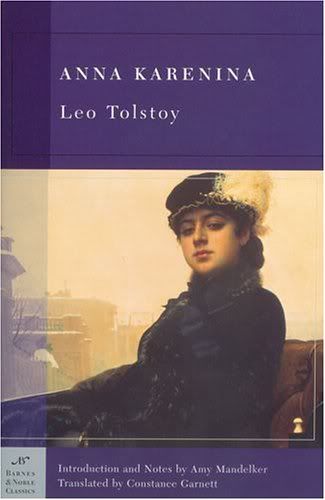
Russian Literature in General and Anna Karenina in Particular


Last week I finished reading Anna Karenina. It was tragic, depressing, passionate, inspiring – with a cast of unforgettable characters and many themes. This story is tightly woven, consisting of a few families that are related in some way, by blood or by marriage. There are many themes in this novel, including inevitable social change in Russia, farming techniques, family life, forgiveness, adultery, death, and marriage. It’s heavy, thoughtful reading – and it often led me to become philosophical and/or thoughtful at times. Be warned – my review/synopsis is rife with spoilers that give away the plot of the book. If you haven’t read it, this blog post might take the enjoyment out of the various surprises and plot twists.


      Levin, one of the two major protagonists, was the easiest character for me to identify with. His religious struggle, his search for meaning in his life, his social awkwardness, and his inability to understand (or tolerate) bureaucracy mirrored some of my own life experiences. His love for the country, for hunting, and for the general welfare of the peasants working on his land endeared me to him quickly. He’s a deep man; he likes to read philosophy – but he busies himself not with an academic occupation, but with a hands-on, labor-intensive one: agriculture. I almost cried for him when Kitty refused his first proposal – it speaks to Tolstoy as a writer that I felt Levin’s anguish at being rejected. Levin is independent and thinks for himself – but does not purposefully challenge society like Anna does.
      Anna, the second protagonist, looks to me like a woman who lets her feelings and moods dictate her life. She is led around by love, by hate, by the refusal of shame. She’s a victim of the double-standard that still exists in society today: if a man is unfaithful, it is ignored – when a woman is unfaithful, she meets with scorn and derision. Regardless, put up next to Levin’s search for happiness – which is for the most part spiritual - Anna’s search for emotional and physical happiness seems selfish in comparison. She eventually performs the ultimate selfish act – suicide – by throwing herself beneath the wheels of a train. She is a tragic character – one who desires love, but is never satisfied; one who desires happiness, but is never satiated.
Vronsky, Anna’s lover, is to me, a repulsive character. He is designed as a hero character, with flaws, yes, but someone to be admired. To be completely honest, I found him petty and shallow. He cared more about how Anna’s damaged status affected his rank in society than he cared about his proposed love’s pain. He cared much about making his child truly his – since their child was born while Anna was married to Alexy Karenin, the child is officially and legally a Karenin, not a Vronsky. He is self-centered and petty. He does have one outstanding quality – although his love for Anna eventually fades a little, he still does love her, and mourns at her passing.
      Anna’s husband, Alexei Karenin, is a high-level bureaucrat with little personality. He is emotionally self-contained and is not very affectionate towards his wife. He has a son with Anna, Seryozha, with which he is unable to truly connect. Anna loves her son dearly, which is much different from the new daughter with Vronsky – she doesn’t seem to be able to connect with her, and lets the staff take care of the baby. Alexei uses this love to his advantage – treating his son as a pawn in game that is the relationship between him and Anna. Later, Alexei is deeply influenced by a society woman who is interested in religion and spirit mediums to refuse a divorce – which influences Anna’s suicide.

There are many other characters that come alive in this novel:
      Sergei Ivanovich, Levin’s half-brother, is a cold intellectual and writer. He and Levin often duel intellectually. While Levin’s arguments sound well-thought-out and well-rounded, Sergei’s seem cold and rigid, and not backed up by any serious thinking or experience. Levin’s brother Nikolai is sickly and thin – he’s an intellectual radical and a drinker. He is cared for by his reformed prostitute girlfriend, Marya. He is a short-lived character, but a pivotal one – his sickness and death is a catalyst for Levin’s spiritual anguish.
Stepan(Stiva) is Anna’s brother, a man who lives for enjoyment and thinks of responsibility later. He has constant money problems throughout the book, and he also indulges in affairs. The first affair starts off the book, with Anna being called in to reconcile the couple. His actions in this regard – the affair – highlight the double standard of adultery. He is chastised lightly, and continues to have affairs, while Anna does the same thing – and is shunned by society and disgraced. Despite this, he is a bright, happy character that it’s hard not to love. He is boisterous and charming, and I was delighted when I read that his wife lamented the rouble he spent sending her a telegram to inform her of some political matter that she could care less about. He sent it, she said, because when he has a few drinks, he can’t help but do it. Ladies and gentlemen, this here is a 19th century DRUNK-DIAL
      Stiva’s wife Dolly is a Shcherbatsky – and sister to another character, Kitty. Dolly has several children with Stiva, and seems to revel in motherhood - and although she does contrast her life with that of Anna (to be free!), she decides she loves her children more than she would enjoy the freedom that she would gain by leaving them. Sadly, Dolly spends most of the book as a victim – of her husband, his infidelity and irresponsibility- and not until later in the book do we actually hear some of her candid thoughts. By the end of the book, she transformed – she was caring, faithful and loving towards her family and friends – in fact, she was one of the only people who would visit Anna despite her ruined reputation.
      Dolly’s sister, Kitty is an interesting character. Although naïve and sheltered, she is loving, religious, and eventually, an attentive wife and mother. Her light, airy religious beliefs contrast to that of her husband, who is consumed with thoughts of death, the meaning of life, and his own mortality. Prince Shcherbatsky (Kitty, Dolly, and Natalie’s father) favors Levin for a suitor of his daughter in the beginning of the novel, while the Princess unwisely prefers Vronsky. When Vronsky fails to do what is expected of him – propose – it doesn’t take long for the couple to argue, then make up. The impression that I got of their marriage was positive – it was a healthy, loving marriage – they aren’t afraid to fight, and they make up quickly – they are very well suited for each other. I also believe that they have the best interests at heart for their children – even if they disagree on the action to be taken.
      In the end, Levin resolves his spiritual anxiety and delights in being a good husband and father, while Anna’s unhappiness drives her to a desperate act. They stand in stark contrast to one another, although what they were searching for was the same: happiness.

Thursday, November 10, 2011

Martin Luther

For the past few weeks, I have been reading about the life and times of Martin Luther - NOT the civil rights activist, the 16th century German religious reformer that may have single-handedly shaped the Western world.

Photobucket

Martin's parents wanted him to become a lawyer - after all, that would bring his family more prestige, and that meant quite a lot in 16th century Germany. But young Martin had a religious experience - he was on horseback during a thunderstorm and a lightning bolt struck near him. In terror, he cried out "Help! Saint Anna, I will become a monk!"
And he did.
But Luther was not content as a monk - he dedicated himself to monastic life, but was eventually ordered by his superior to teach theology at the University of Wittenburg. It was during this time that the Catholic Church began selling indulgences again - a practice that Luther abhorred, because it implied that you could "buy" your way into heaven by good works, or purchasing indulgences from the church. In 1517, Luther wrote to his bishop, Albert of Mainz, protesting the sale of indulgences. This was his famous '95 theses.' Legend has it that he nailed the 95 theses to the door of the church, but there is little to support this claim.
In 1518, friends of Luther translated the 95 Theses from Latin into German, printed and disseminated them. Within two weeks, copies had spread throughout Germany; within two months throughout Europe.
Luther, in the beginning, did not intend to attack the Church. Like many of his time, he was unhappy with the actions of the Church, and wanted answers. He got his answer: in 1521, he was excommunicated for his writings.
Luther claimed that a personal relationship with God was possible. This was revolutionary - for over a thousand years, the pious had to speak to God through a religious intermediary - a priest. The Church ruled spiritual life - it held the people at it's mercy, because without it's services, one could not enter heaven. The church performed baptisms, performed mass, offered communion, heard confessions, performed marriage rites, and death rites.
In Luther's new churches, the congregation sang the hymns. Sermons were read in German - NOT Latin. Pastors could marry. Luther himself even translated the bible into German so that laypeople didn't need to learn Latin to read God's word.

To put it all into perspective: Martin Luther reluctantly antagonized the largest, most powerful institution of his day - and WON.

Thursday, October 27, 2011

A Bad Case of the What Ifs

Have you ever had a time, where you truly doubted yourself? All of these possibilities flood your head, and you wonder...what if?

What if:

I don't know what I'm doing?
I can't find a job after college?
I can't handle a job, if I manage to get one?
I hate my job - if I get one?
this isn't what I'm good at?
all I'm good at...is being a student? What do I do then?

All of these went through my head. I know that I'm scared; that I don't think I can handle basic responsibilities. I'm pretty sure it's normal (even for a 28-yr-old) - but I'm still scared anyway.

Thanks for tuning in - hopefully the next post will be a little more upbeat.

Friday, October 14, 2011

The History of Libraries

This week, I've been reading about the history of libraries. I am going to college right now, to earn my AAS degree in Library Science, so that I may one day become a Library Technician. Out of all the subjects we have been learning - the Dewey Decimal System, the Library of Congress Classification System, etc., what most interests me is the history and evolution of the library.
First of all, in ancient times, not everyone could read - whether in Asia, Greece, Rome, or Egypt, education was for the rich, the privileged, and the clergy who advised them. Libraries in Europe were either private or connected to churches or monasteries until the Renaissance, when the love of knowledge that came from the Middle Eastern region flowed in to Europe.
The religion of Islam greatly influenced our book culture of today. They built great libraries, amassed monstrous collections, their scribes beautifully illuminated the texts, and the bindings were coveted for their richness and sumptuousness. They even collected and reproduced the literature of their rivals, the Greeks.
Libraries were, in general, open only to the higher classes, scientists, and the clergy for study and research. The first "modern" library, according to most historians, is the library at San Marco in Florence, built by Cosimo de Medici, a great patron of the arts in Renaissance Italy. This was only open to the learned and upper classes as well - but it also illustrated how libraries were used to show power and influence, especially of the Medici family. The books in this library were chosen carefully - they showcased the piety and the intelligence of the Medicis, as well as their views on humanism, culture, and custom. Also chosen were books that were once owned by illustrious individuals, people that the Medicis were all to happy to have their name associated with.
With the invention of moving type in Europe (the Chinese had invented this much earlier) literacy exploded, and so did the demand for books. A person would pick up the printed pages at the printer, then take them to a "binder" - to bind the pages together in the manner he chose - whether elaborate hard binding, or simple leather.
Books have been made from many materials - wood, metal, paper, papyrus, parchment, bamboo, stone, clay, and even wax. They have taken many forms - scrolls, writing on rock (for easy copying by rubbing), long bound bamboo books, the wax tablet, the codex, the wooden tablet, and the bound book with cover as we know it today. If you are more interested in the history of libraries, I suggest heading to your local public library and borrowing 'Library - An Unquiet History' by Matthew Battles:

Photobucket

It's an entertaining read!